

Once upon a time, in a nation where tailors double as politicians and fashion sparks protest, a skirt just flipped the script on Nigeria’s most iconic youth institution. The National Youth Service Corps (NYSC)—known for its khaki pride and para-military precision—just got a legal slap that has left its iron-pressed trousers shaking.
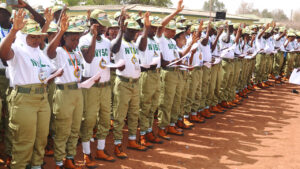
The Abuja Federal High Court, in a landmark judgment, ruled that the NYSC must allow female corps members to wear skirts, stating clearly that the ban on such attire violates constitutionally guaranteed rights to religion and expression.
But beyond the courtroom drama lies a bigger question—has NYSC been silently violating women’s rights all along?
Let’s talk about it.
The Uniform Code Nobody Really Questioned
The NYSC was created in 1973 after the civil war, a noble attempt to “unite the nation’s youth” in service.
But along the line, it also became a uniformed machine with strict codes: wear this, cut your hair that way, march straight, obey without complaint.
For decades, female corps members—Muslims, conservative Christians, traditionalists—were forced to wear trousers, despite cultural or religious objections.
Many who resisted were denied certificates. Others were humiliated or thrown out of orientation camps. And Nigeria, ever desensitised to quiet injustices, barely blinked.
Until now.
The Women Who Fought Back (And Won)
In the spotlight is a Christian woman who sued NYSC for violating her religious rights by insisting she wear trousers.
The court agreed, declaring the act “unconstitutional and discriminatory.” Not only that, the judge ordered NYSC to issue discharge certificates to all affected female corps members—some of whom had waited years.
This ruling has cracked open a long-sealed conversation: how many other “policies” have we normalised that oppress rather than unite?
Trousers As Control? What The Dress Code Really Represents
Let’s be honest—this has never been about just clothing.
The NYSC dress code was built on a military foundation. In that system, individuality is stripped away, obedience is the goal. But unlike the military, NYSC isn’t a choice—it’s compulsory. That changes everything.
When young women are forced to pick between their beliefs and their futures, that’s not discipline; that’s coercion.
For decades, female corps members had to “compromise” because failure to comply meant disqualification.
Imagine spending four or five years in a Nigerian university, surviving ASUU strikes, dodging kidnappers, carrying your bucket to the hostel bathroom—only to be denied a certificate because you wore a skirt?
Sounds insane, right? Yet it’s been the norm.
The Cultural Double Standards: Yoruba Buba, Igbo George, Hausa Hijab
Nigeria is a beautiful mess of cultures. In Sokoto, trousers on women raise eyebrows. In Aba, mini skirts can sell wrappers. And in Lagos, anything goes—just wear confidence.
Yet the NYSC uniform pretends we’re all from the same village.
Also Read: Charting Destiny: How Esther Okoronkwo Became The Super Falcons’ Dynamic X‑Factor
What’s worse is how some corps members have quietly been allowed “special waivers” depending on their religion or tribe—while others were punished harshly for the same choices. This inconsistency exposes a system that operates more on vibes than law.
The Quiet War On Women’s Autonomy
The core issue here is simple: choice.
Women have a right to decide how they dress, especially when the alternative doesn’t compromise security, modesty, or professionalism. But for decades, NYSC said: wear trousers or get out.
It’s no surprise that some now say NYSC—ironically designed to promote national unity—has been quietly pushing a discriminatory uniform policy that alienates part of the population it claims to unite.
It Was Never Just About Skirts
This isn’t just a legal victory; it’s a cultural reckoning. The NYSC, and Nigeria by extension, must finally face the contradictions between unity and uniformity.
For years, a pair of trousers symbolized obedience—but also oppression. Now, a single skirt has challenged an entire institution.
The question now is: What else have we normalized that needs to be unraveled?
Because if a skirt can shake the system, what happens when we all stand up in our own truth?